Victoria Walters reviews an impressive adaptation of Harper Lee’s prize winning novel
“Our darkest days have always been followed by our finest hours,” insists Atticus Finch early in Aaron Sorkin’s powerful stage adaptation of To Kill A Mockingbird, arriving in Bath this week as part of a nationwide tour. In today’s political climate, the line feels sharply apposite, setting the tone for a production that refuses to shy away from the novel’s most uncomfortable truths in its portrayal of racial injustice in the 1930s American Deep South.
Harper Lee’s Pulitzer Prize-winning novel, based on her own childhood – a perennial feature on both GCSE set-text lists and banned books lists – remains one of the most widely read and best-loved works of American literature.
Sorkin, the Academy Award-winning writer best known for The West Wing, stays broadly faithful to the original text while reworking its structure to illuminate its key themes for a contemporary audience. His trademark rapid-fire dialogue propels the narrative with urgency and clarity.
An effective shift is to hand the narration to the three children – Scout, Jem and their eccentrically lovable friend Dill – rather than relying solely on Scout’s perspective as in the novel. Casting adults as children can be risky, but here it works. The trio brings an appealing, clear-eyed commentary as well as a welcome thread of humour.
Anna Munden’s feisty, whip-smart Scout is hugely engaging; Gabriel Scott lends her brother Jem a convincing stubbornness and moral weight; Dylan Malyn, in his professional stage debut, is a heartbreakingly vulnerable and endearing Dill. Their presence lifts the darker material without undermining it, reminding us that this is, at its core, a child’s-eye view of an adult world.

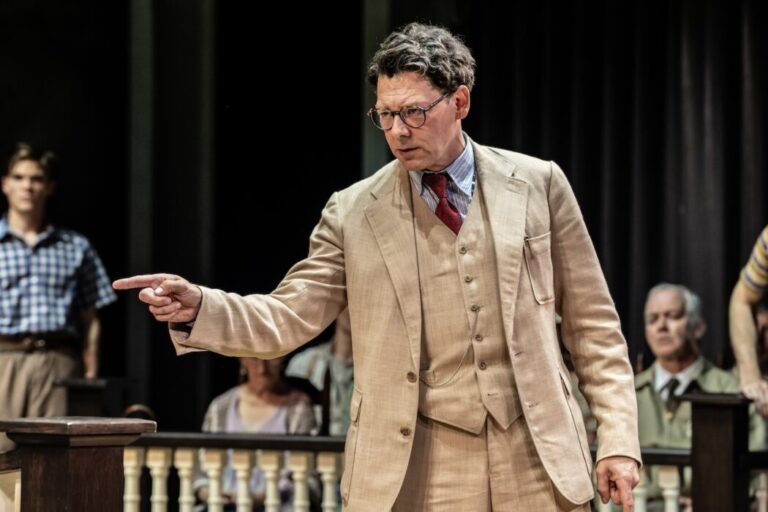
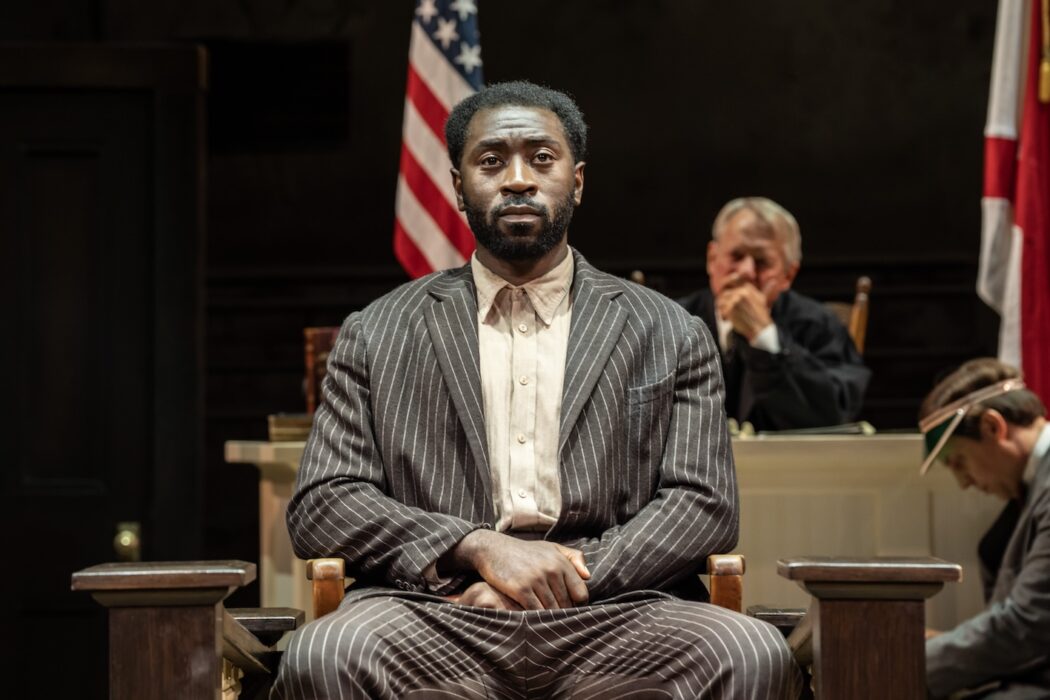
At the heart of the production is Richard Coyle’s compelling Atticus Finch – a weary idealist whose moral decency is both his strength and his flaw. As he defends Tom Robinson (played with beautifully resigned dignity by Aaron Shosanya), the innocent Black man maliciously accused of rape, the limitations of Atticus’s belief that there is goodness to be found in everyone – even the racists falsely accusing Tom – become painfully clear.
It’s hard to escape the idea that Lee’s novel is what would now be understood as a ‘white saviour’ narrative. Sorkin counters this by positioning Calpurnia, the Finches’ long-time maid, squarely as Atticus’s counterpart. Andrea Davy is superb in the role; her performance radiates emotional intelligence and a simmering rage that crackles with quiet power as she criticises Atticus for expecting her to be grateful to him for doing what is clearly the right thing.

The play confronts its most difficult material directly. Racial slurs land like physical blows, and the moment when a hooded mob descends on Tom Robinson is chilling.
The naturalistic set, while detailed, involves frequent scene changes that sometimes interrupt the pace of the play and become slightly distracting, and the wider ensemble feels a little underused. It is an interesting choice not to use any of them to play the members of the jury, asking the audience instead to imagine the ‘twelve white farmers’ whose verdict seals Tom Robinson’s fate. Perhaps this is a deliberate decision to prompt the audience to interrogate their own assumptions.
The production builds to an emotionally devastating and rousing conclusion. Sorkin has said that this is ultimately a story about ‘heroes without capes… trying to be better’. This riveting production captures exactly that spirit. It is bold, gripping and affecting theatre – and if you haven’t already secured tickets, I urge you to move quickly and catch it while it’s in town.
To Kill A Mockingbird runs at the Theatre Royal Bath until 22 November. For tickets go to www.theatreroyal.org.uk/events/to-kill-a-mockingbird/